How is sludge formed at the bottom of crude oil storage tanks?
The formation of oil sludge at the bottom of crude oil storage tanks is not caused by a single factor. Instead, it is the inevitable result of the interaction of multiple factors such as physical sedimentation, chemical transformation, and changes in thermodynamic conditions during the long-term static storage of various complex components in the crude oil. The formation mechanism can be professionally analyzed from the following core dimensions:
Firstly, gravity sedimentation and the redistribution of components are the fundamental physical processes of oil sludge formation. Crude oil is an extremely complex mixture that inevitably contains high-melting-point waxes, asphaltenes, resins, and mechanical impurities such as sand and heavy metal salts. During the long-term static storage in the tank, under the influence of gravity, these denser components and suspended particles will slowly settle downward. Studies have shown that after long-term storage, the wax content in the oil sludge can sharply increase from 3% in the upper part of the crude oil to around 33%, and the asphaltene content will also increase significantly. This significant redistribution lays the material foundation for the formation of oil sludge.
Secondly, the disruption of the colloid system and the selective deposition of polar compounds are the key chemical driving forces. The asphaltenes and resins in the crude oil originally maintain a relatively stable colloid suspension state. However, with the extension of storage time and fluctuations in external temperature, this thermodynamic equilibrium is disrupted. Especially the polar compounds rich in sulfur and oxygen-containing compounds (such as sulfoxides and cycloalkanoic acids) are prone to undergo oxidation transformation and selective deposition. These polar substances will adsorb on the surfaces of inorganic mineral particles such as clay and rust, forming insoluble micelles (Micelles).
Thirdly, the aggregation of microscopic micelles and the macroscopic stratification are the evolutionary paths of oil sludge formation. The formed tiny micelles will continuously absorb the surrounding polar components, water, and heavy waxes, gradually coalescing and merging into larger "super micelles". As the mass of these composite particles increases, they eventually overcome the buoyancy and viscosity resistance of the crude oil and completely separate from the crude oil and precipitate to the bottom of the tank.
Finally, in the macroscopic structure, the oil sludge at the bottom of the tank will exhibit obvious stratification evolution characteristics over time. The top layer is the "initial oil sludge", which is in an unstable state and still exchanges substances with the crude oil; the middle layer is the "upper oil sludge", which is the main deposition area where asphaltene micelles and heavy waxes continuously fuse and solidify; the bottom layer is the "lower oil sludge", which becomes extremely dense, hard, and stable with the accumulation of years.
In summary, the formation of oil sludge at the bottom of crude oil storage tanks is a complex physical and chemical process involving wax, asphaltene, polar compounds, and inorganic impurities under the influence of gravity, temperature, and oxidation.
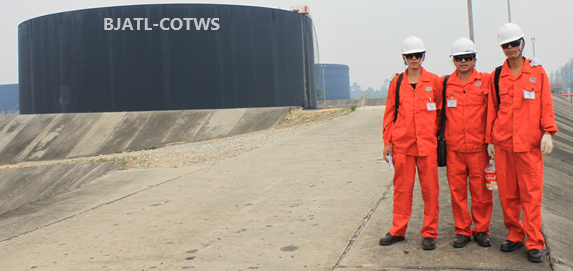
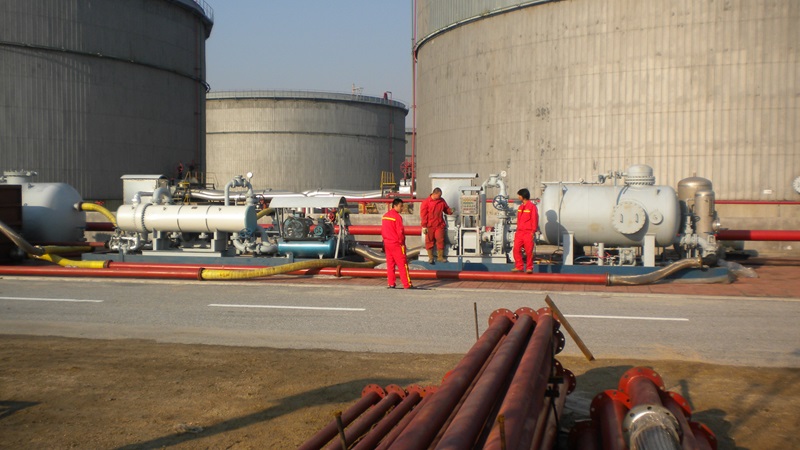
The mechanical cleaning equipment for crude oil storage tanks of BJATL can achieve the maximum physical recovery and complete cleaning of the storage tanks by using a staged cleaning process with the same type of oil and hot water based on the physical properties of the oil sludge.